
Strength training for cyclists
Typically cyclists have been prone to overlooking weight training in favour of spending more time in the saddle. Whilst aerobic fitness remains a fundamental part of cycling performance, the health and performance benefits associated with strength training should no longer be ignored.
Why should anyone weight train?
It is widely acknowledged that regular weight training can lead to health benefits such as improving muscle tone and strength which in turn helps to protect joints from injury. Better muscle tone and strength, helps to improve posture and maintain and improve flexibility and balance. By weight lifting or moving your own body weight, you can increase your muscle mass, which in turn raises your resting metabolic rate (i.e. the amount of energy you burn when doing nothing). This means that when you are at rest, the greater your muscle mass, the greater the amount of energy you will burn!
Why should cyclists weight train?
Introducing weight training may also help you become a stronger and more efficient cyclist. Research conducted using lower body weights has been shown to increase lower limb strength, leading to an increase in power output.1 An increase in muscular strength, can also improve endurance, increasing the time it takes muscles to work to exhaustion.2 These improvements in strength and performance are largely neurological, meaning that your body is learning how to use the muscle it has better, rather than building excessive muscle mass.
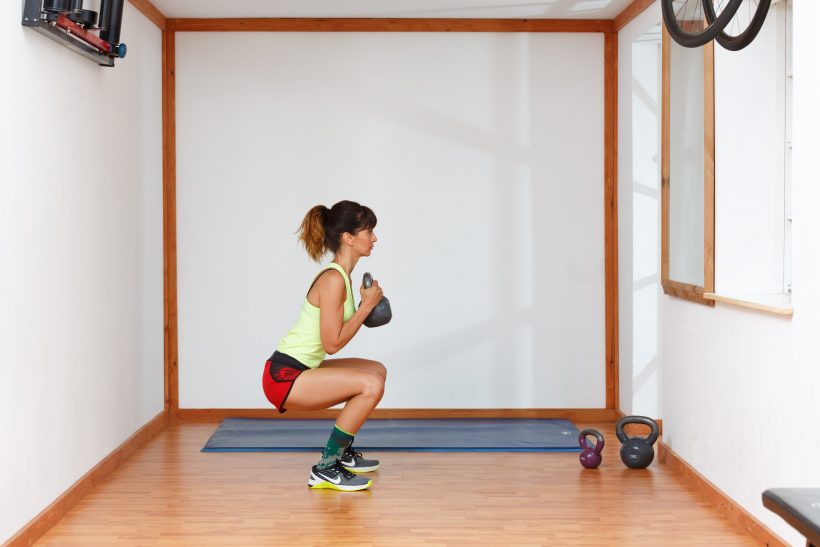
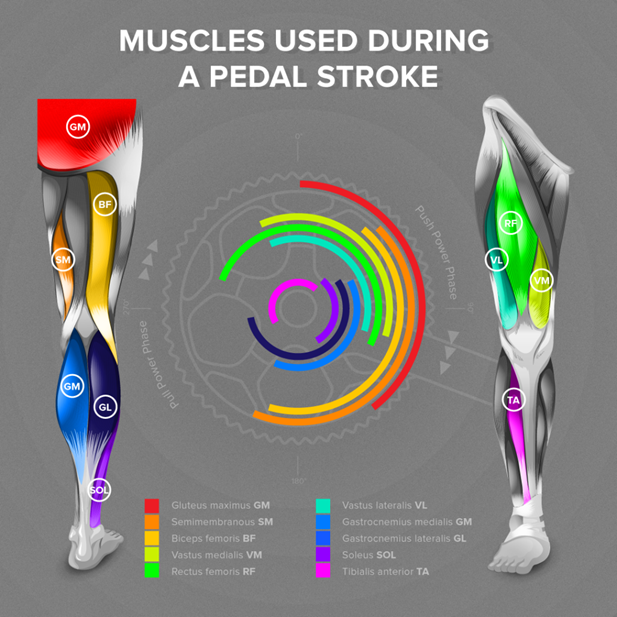
During cycling you primarily utilise three major muscle groups (i.e. quads, gluteals and hamstrings) to turn the pedals in a push and pull motion during each rotation. Targeting these muscle groups by placing emphasis on functional exercises such as squats enables you to strengthen the same movement patterns used as when you cycling, thus maximising neurological adaptations and strength gains. The sequential order in which your lower limb muscles are recruited in a pedal stroke is shown in the infographic below.
The Fit Cycle also recommends upper body weights to incorporate your arms and torso. Developing a strong and stable core eliminates any excessive side to side movement or ‘rocking’. Rocking leads to a reduction in force transfer from your legs to your upper body, resulting in a loss of power. By providing a stable platform for our hips, thighs and knees to work from we reduce the chances of overusing other muscles in order to compensate for our lack of core stability, which could result in injury.
Increasing your overall muscle strength and stability can also lead to an improvement in cycling efficiency. This will mean you are likely to notice significant improvements in your cycling speeds and power outputs, for the same perceived effort!
Weight training myth busting
So why isn’t weight training more popular with cyclists, already? In the past, cyclists have been scared of gaining weight via developing more muscle mass through training. Clearly there is a trade-off between muscle gain to increase performance and metabolic rate versus weight gained as a result of resistance training. However, to provide an example, if you can increase your lean mass by 1kg (as a result of resistance training) and reduce your fat mass by 1kg (as a result of increased resting metabolic rate), the net result is you weigh the same, but you have increased your overall strength, ability to generate power and have reduced your injury risk.
Why not try incorporating weight training sessions into your training plan? If unsure of how to do so, The Fit Cycle plans include all the exercises you should carry out, and how to videos explaining how to perform each exercise.
Ditch the scales, and focus on improving your performance on the bike. Strength training could well be your missing link!
References
- Ronnestad, B. R., et al. (2011). “Strength training improves 5-min all-out performance following 185 min of cycling.” Scand J Med Sci Sports 21(2): 250-259.
- Rønnestad BR, Mujika I (2014). Optimizing strength training for running and cycling endurance performance: A review. Scand J Med Sci Sports. .